Summer Palace
The largest and best-preserved imperial garden in China, centered around Kunming Lake and Longevity Hill. A stunning blend of natural landscape and classical Chinese architecture that served as the imperial family’s summer retreat.
Why It’s Worth Visiting
The Summer Palace is China's greatest imperial garden and the most beautiful open space in Beijing — 290 hectares of lake, hill, and painted corridor assembled on a scale that makes you feel the Qing court's wealth with every step.
Where the Forbidden City impresses with power, the Summer Palace seduces with pleasure: boat rides on Kunming Lake, the world's longest painted corridor, and the marble boat of Empress Dowager Cixi's rebuilding. It is the most romantic, most relaxing of Beijing's World Heritage sites — and the best escape when the city heat builds.
What to Expect
The Summer Palace is the largest imperial garden in China, and the first view of Kunming Lake explains why the Qing emperors chose this spot to escape Beijing's summer heat. The lake — a third of the park's 290 hectares — sits in a natural basin with Longevity Hill rising from its northern shore, crowned by the Tower of Buddhist Incense.
The classic walk hugs the lake's north shore. The Long Corridor, 728 meters of painted wooden galleries running from the East Palace Gate toward the Marble Boat, contains over 14,000 individual paintings — scenes from classical novels, flowers, birds, and landscapes — and is the world's longest painted corridor. Each beam is a small artwork; budget time to actually look up.
The defining Summer Palace moment, though, is the boat ride. Rent a dragon-painted pedal boat or join a lake cruise, and the whole composition reassembles itself from the water: the hill, the temple, the Seventeen-Arch Bridge arcing toward South Lake Island. The park rewards slow movement and lake-light.
Behind the beauty is a dramatic rebuilding story. The Summer Palace was destroyed and rebuilt twice — first by Anglo-French forces in 1860, then again during the Boxer Rebellion of 1900. Empress Dowager Cixi oversaw the second reconstruction in the 1880s, and her decisions shaped what you see: the Marble Boat, a stone 'warship' pavilion built (critics joked) with funds diverted from the navy, and the 17-meter Tower of Buddhist Incense, the park's sacred heart.
Climb Longevity Hill from the rear to reach the Tower of Buddhist Incense's courtyard, then descend the other side for a panorama over the lake and the Seventeen-Arch Bridge. The hill's back slope is far quieter than the lakeside and offers some of the best photo angles in the park.
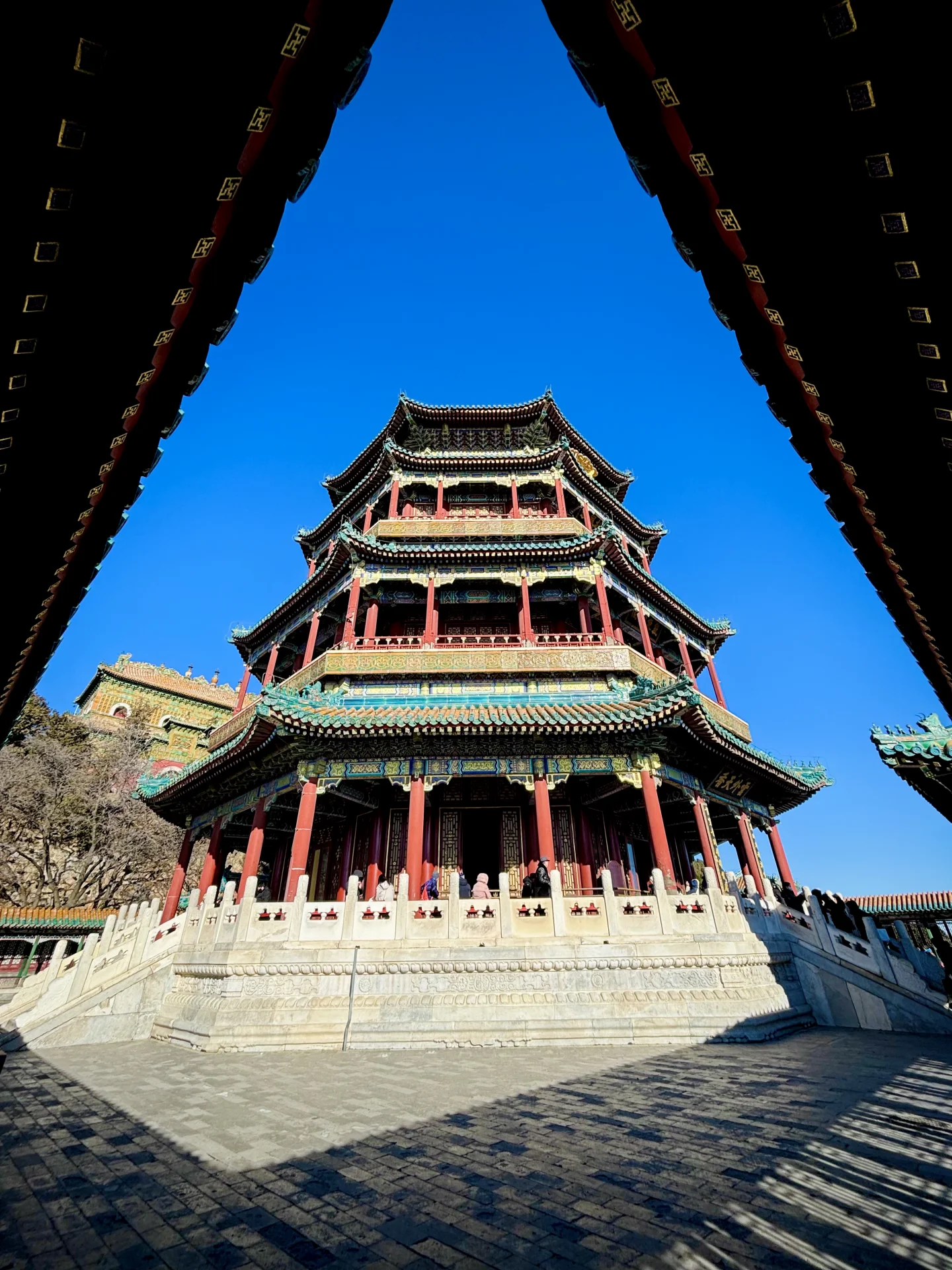
From the Tower of Buddhist Incense looking south across Kunming Lake — the full panorama of the lake, Seventeen-Arch Bridge, and distant Western Hills. Late afternoon light is best.
| Ticket Price | CNY 20 – CNY 30 |
| Duration | 3-4 hours |
| Nearest Subway | Beigongmen (Line 4), Exit D |
| Best Season | Spring, Summer, Autumn |
| Best For | All visitors, including families |
Must-See Highlights
- Long Corridor
- Marble Boat
- Kunming Lake
- Tower of Buddhist Incense
- Seventeen-Arch Bridge
How to Get There
Take Line 4 to Beigongmen station (Exit D). The attraction entrance is a short walk from the station.
Beijing subway operates from approximately 5am to 11pm daily. Fares range from CNY 3 to 9. English signage and announcements are available on all lines.
How to Spend Your Time
- 1
Enter via the South Gate to arrive directly at Kunming Lake, away from the tour-bus East Gate.
- 2
Follow the lakeshore clockwise: Seventeen-Arch Bridge, then the Long Corridor.
- 3
Climb Longevity Hill from the rear to the Tower of Buddhist Incense.
- 4
End at the Marble Boat and take a lake cruise back toward the East Gate.
Insider\u2019s Tip
Enter through the South Gate instead of the crowded East Palace Gate — you’ll arrive directly at Kunming Lake. Follow the lakeshore clockwise to the Marble Boat, then climb Longevity Hill from the rear. You’ll see the highlights in reverse order with half the crowds.
A Bit of History
The Summer Palace was destroyed and rebuilt twice: first by Anglo-French forces in 1860, then again during the Boxer Rebellion in 1900. Empress Dowager Cixi rebuilt it in 1886, famously diverting navy funds to finance the marble boat and the Long Corridor — the world’s longest painted corridor at 728 meters.
Beat the Crowds
Spring weekends are busiest when magnolias bloom in late March to mid-April. Visit on a weekday morning in May or September for the best balance.
Where to Eat Nearby
Walk 15 minutes east to the Beijing University west gate area for dozens of cheap student restaurants. Bai Jia Da Yuan on Suzhou Street is the splurge: imperial-style dining in a Qing Dynasty mansion.
Best Photo Spot
From the Tower of Buddhist Incense looking south across Kunming Lake — the full panorama of the lake, Seventeen-Arch Bridge, and distant Western Hills. Late afternoon light is best.
Good to Know
- The combined ticket (CNY 30) covers the Long Corridor, Tower of Buddhist Incense, and the big temple.
- The park is enormous — a full loop on foot takes 4+ hours; the lake cruise is the shortcut.
- Spring magnolias (late March-April) are a highlight; the lakeside willows green up first.
- Suzhou Street, a replica Qing shopping street inside the park, is free with the combined ticket.
- Lake cruises between piers run every 20-30 minutes and cost about CNY 30 per leg.
Summer Palace: Frequently Asked Questions
How long do I need at the Summer Palace?
Three to four hours covers the Long Corridor, Longevity Hill, and a lake cruise. A full loop on foot with stops is closer to five. It is a half-day attraction — pair it with a relaxed lunch or the nearby Old Summer Palace ruins.
Which entrance should I use?
The South Gate lands you directly at Kunming Lake and avoids the tour-bus crowds at the East Palace Gate. The East Gate is the classic entrance but the busiest.
Is the Marble Boat worth seeing?
Yes, briefly — it is the park's most famous surviving symbol of Empress Dowager Cixi's rebuilding and makes a great photo. The real highlights are the Long Corridor and the Tower of Buddhist Incense.
Can I take a boat on Kunming Lake?
Yes — pedal boats and electric boats rent by the lakeshore in summer, and scheduled lake cruises connect the main piers year-round (weather permitting). Winter freezes the lake into a skating rink.